

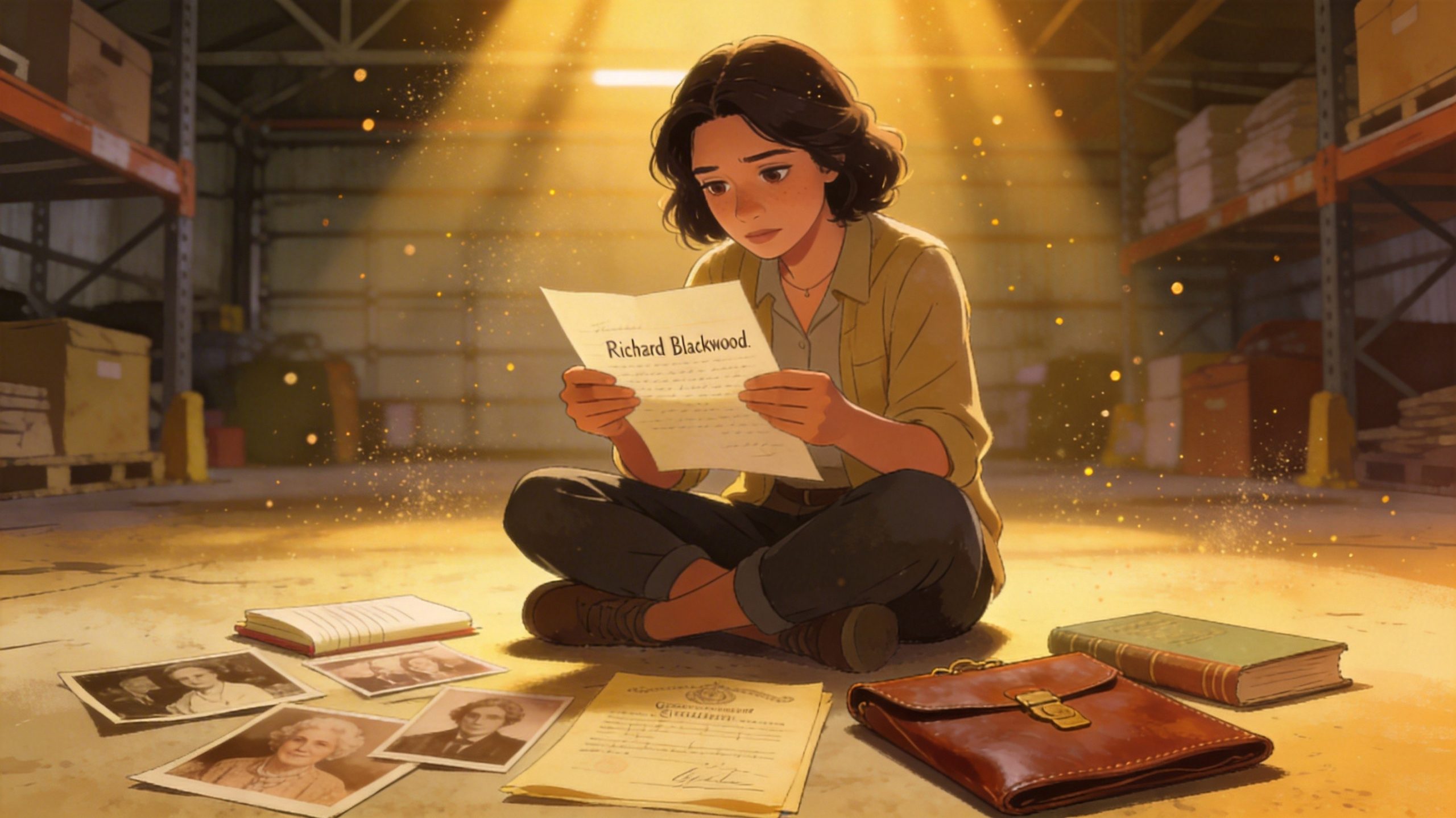
Three months after the trial, I was going through boxes of my grandmother’s belongings that had been stored in a warehouse after Alexander stole my inheritance. Most of it was personal—photographs, journals, personal correspondence.
But in one box, tucked between journals from the 1970s, I found a letter addressed to me.
It was dated the year my grandmother died.
Dear Emma,
If you’re reading this, something has gone wrong with the trust I established. The Blackwood Industries fortune wasn’t just money—it was meant to be used to build something that matters.
I built Blackwood Industries from nothing, starting with a small textile factory in Queens. I believed that business could be a force for good—creating jobs, supporting families, building communities. But I also learned that money attracts people who want to use it for their own purposes.
The trust I established has safeguards. But safeguards can be broken. Laws can be circumvented. And people who are supposed to protect you can betray you.
If you’ve lost everything, I want you to know something: You haven’t really lost anything. The Blackwood legacy isn’t the money. It’s the ability to build from nothing. The ability to create value. The ability to transform betrayal into something better.
I’ve left you something—not in the trust, but outside of it. A piece of property in Brooklyn that never made it into the official records. A warehouse that I used as my first factory.
The deed is in the envelope with this letter. It’s yours, free and clear. Use it however you want. Build something new. Create something that matters.
Your grandmother believed in you. And so do I.
With love,
Richard Blackwood
I sat on the floor of the warehouse, surrounded by my grandmother’s boxes, reading the letter three times. My father had signed it—Richard Blackwood—the same man who had conspired with Alexander’s father to steal my inheritance.
The same man who was now serving eight years in federal prison.
But the letter wasn’t just from the father who had betrayed me. It was from the man who had married my grandmother, who had loved her, who had believed in her legacy enough to hide this property from the trust documents.
He had known that his son—my father—might try to misuse the Blackwood fortune. He had anticipated that something like this might happen.
The next morning, I took the deed to Clara.
“This is legitimate,” she said after reviewing it. “A warehouse in Brooklyn, purchased by your grandfather in 1968, never transferred into any trust or corporate entity. It’s been in his name alone, with a transfer-on-death designation that went to you when your grandmother died.”
She paused.
“How did this exist without anyone knowing about it?”
“My grandfather hid it,” I said. “He knew my father might misuse the Blackwood fortune. This was his safeguard.”
The warehouse was in a part of Brooklyn that had been neglected for decades—warehouses and factories that had closed in the 1980s and never reopened. But it was structurally sound, and the location was prime for redevelopment.
Elena brought in real estate developers from the Phoenix Network. Marcus brought in engineers. Clara handled the legal work to ensure there were no hidden claims or complications.
Three months after finding the letter, we broke ground on what would become the new Phoenix Connect headquarters—a mixed-use campus that included:
Manufacturing facilities for ethical suppliers in the Phoenix Connect network
A tech incubator for Phoenix Grant recipients—startups founded by women who’d been underestimated or undervalued
A training program for women transitioning into tech and manufacturing careers
Community spaces for the Phoenix Network and other women’s empowerment organizations
The warehouse my grandfather had bought in 1968 became the foundation of something bigger than Phoenix Connect. It became a movement.


