

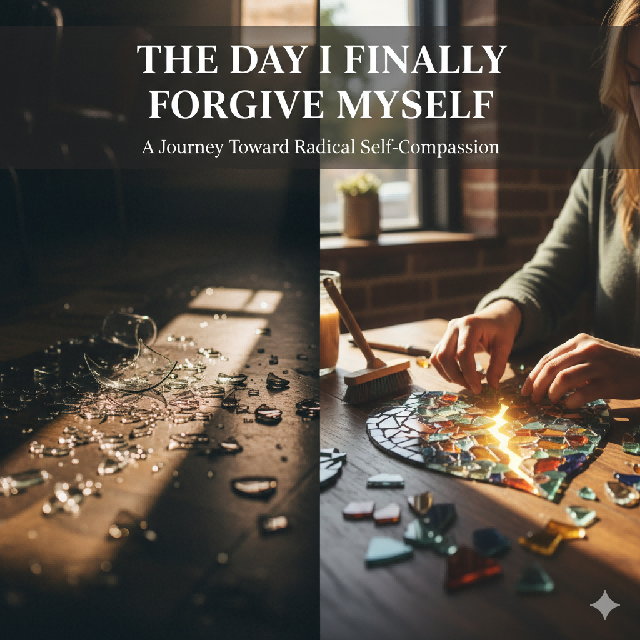
We are often told that forgiveness is a gift we give to others to set ourselves free. We hear sermons on it, read bestsellers about it, and watch cinematic climaxes where the hero finally lets a villain go, the music swelling as the burden lifts. But what happens when the person you cannot forgive is the one staring back at you in the mirror? What do you do when the villain and the victim share the same heartbeat, and there is no distance between the perpetrator and the judge?
For seven years, I carried a heavy, jagged stone in my chest. It wasn’t put there by a cruel boss, an unfaithful partner, or a distant parent. I placed it there myself on a rainy Tuesday in October—a day that remains frozen in my mind like a crime scene under yellow tape. At the time, I was working in logistics, a high-stakes environment where precision is the only currency. A single moment of professional negligence on my part—a misinterpreted email, a missed deadline—cost a small, multi-generational family business their primary contract. I didn’t just make a mistake; in the suffocating silence of my own mind, I became the mistake. I allowed that single failure to define the entirety of my existence, effectively erasing every good deed I had ever done.
The Architect of My Own Prison
In the high-achieving culture of North America, we are conditioned from the playground to the boardroom to believe that our worth is tied to our utility, our output, and our relentless perfection. We live in a society that treats human beings like hardware; if there’s a glitch, the system is seen as broken. When we fail, we don’t just feel guilt—the healthy, albeit painful, realization that we did something bad. Instead, we succumb to shame—the toxic, paralyzing belief that we are bad.
We treat our souls like a credit score: one major default, one missed payment on our “moral obligations,” and we assume we are bankrupt forever. I spent years in this state of self-imposed insolvency. I felt that if I stopped suffering, I was somehow letting myself off the hook too easily. I believed that my misery was the only way to prove to the world that I was a “good person” who cared about my errors. If I was happy, I was complicit. If I was lighthearted, I was indifferent.
The Weight of the “What Ifs”
My haunting didn’t involve ghosts or rattling chains; it was far more clinical. It involved “What Ifs.”
What if I had stayed an hour later? What if I had double-checked that final spreadsheet instead of rushing to a dinner I don’t even remember now? I spent years performing a slow-motion autopsy on my past, picking apart the “dead tissue” of that October day with the precision of a surgeon who wanted the patient to stay on the table. I denied myself the simple graces of life—a sunset, a warm meal, the touch of a loved one—because joy felt like an insult to the people I had let down.
Every time I reached a new milestone—earned a promotion at a new firm or received a compliment from a peer—a cold, cynical voice in my head would whisper, “Don’t get too comfortable. Remember what you did. If they knew the real you—the you from that October—they wouldn’t be smiling.” This is the tragedy of self-unforgiveness: it creates a “hollow success.” You move forward in the world, but your spirit remains tethered to a version of yourself that no longer exists. I was using self-punishment as a shield, a twisted form of penance where the suffering never ended because the judge—me—refused to set a release date.
The Breaking Point: A Lesson in Glass
The shift didn’t happen during a grand epiphany or a high-priced mountain retreat involving sage and silence. It happened in a salt-stained, crowded diner in downtown Toronto on a mundane Sunday morning, watching an old man drop a tray of glasses.
The sound of shattering glass was deafening, cutting through the low hum of brunch conversation and the clinking of silverware. The man, a veteran waiter named Henry whose hands had begun to shake with the onset of age, froze. His face flushed a deep, bruised red—a shade of shame I recognized instantly. It was the color of my own heart. The restaurant went silent for a heartbeat, that awkward, heavy pause where everyone waits to see who will yell, who will complain, or who will laugh.
But then, the manager did something I didn’t expect. She didn’t scold him. She didn’t roll her eyes or ask him why he was so clumsy. She simply knelt beside him on the sticky linoleum, put a firm, kind hand on his shoulder, and said, “It’s just glass, Henry. We’ve all been there. Let’s get you a broom so you don’t cut yourself.”
In that mundane, greasy-spoon moment, the air seemed to clear. I saw my own life mirrored in those sparkling shards on the floor. I realized I had been standing among my own shattered glass for seven years, bare-footed and bleeding, waiting for someone—an authority figure, a god, a victim—to give me permission to clean it up. I had been waiting for a manager who wasn’t coming because the restaurant was mine, and the only one who could hand me the broom was me.
The Ritual of Release: Reclaiming the Narrative
Forgiveness isn’t a nebulous feeling that washes over you like a warm tide; it’s a rigorous, daily, and often inconvenient decision. That evening, I sat in the quiet of my apartment and did something that felt absurdly vulnerable: I wrote a letter. Not to the clients I had lost, but to the version of myself that existed seven years ago.
I acknowledged the pain. I acknowledged the error without the cushioning of excuses. But then, I forced myself to look at the context. I realized that the person who made that mistake was exhausted, operating on four hours of sleep, trying to carry the weight of a crumbling department on his shoulders. He was fundamentally, beautifully, and tragically human.
I wrote: “You were tired. You were overwhelmed. You were trying to be a hero in a system designed to break you. And being human is not a crime that requires a life sentence without the possibility of parole.”
I realized that by refusing to forgive myself, I was stuck in a metaphysical time loop. I was trying to edit a past that was already written in permanent ink. The only thing I could change was the narrative of the present—the story I told myself about what that mistake meant. It didn’t mean I was a failure; it meant I had failed. The distinction is the difference between life and death.
What it Means to Move Forward: The Mosaic of the Soul
Forgiving yourself doesn’t mean forgetting what happened. It doesn’t mean you stop caring about the consequences of your actions or that you become a narcissist devoid of accountability. Instead, it means removing the “Moral Debt” sign from your heart so you can actually be of use to the world again. A person paralyzed by shame cannot help anyone; they are too busy tending to their own wounds. A person healed by grace, however, has the strength to reach out and help others through their own brokenness.
When I finally whispered those words—”I forgive you”—the world didn’t change. The rain still fell on the grey streets of Toronto, and the financial loss from years ago wasn’t magically erased from the ledgers. But my relationship with the mirror changed.
I realized that my mistakes are part of my mosaic. A mosaic is made of broken pieces, sharp edges, and discarded fragments. If you look at one single piece, it looks like a disaster. But when those pieces are set in the mortar of experience, time, and radical self-compassion, they create a picture that is far more complex and beautiful than a plain, unbroken surface. The cracks are where the light gets in, and the repairs are where the strength lies.
To anyone reading this who is still holding onto a jagged stone from a year, a decade, or a lifetime ago: The war is over. You have served enough time in the prison of your own mind. You have paid the interest on your guilt a thousand times over. You are allowed to come home to yourself.
The most radical act of rebellion in a world that demands impossible, sterile perfection is to look at your flawed, messy, beautiful self and say, “I am more than my worst day.” And then, just like Henry in the diner, you pick up the broom, you clear the floor with dignity, and you keep going. You don’t have to be perfect to be worthy. You just have to be here.


