

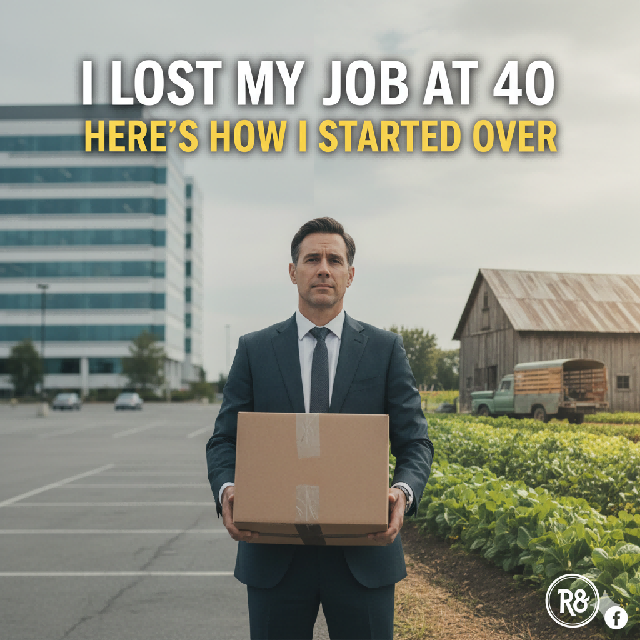
The cardboard box felt heavier than it looked, a physical manifestation of a collapsed world. It contained twelve years of my life: a “Manager of the Year” plaque with a slightly tarnished silver finish, a framed photo of my kids laughing at the company picnic, and a chipped coffee mug that said World’s Best Problem Solver—a title that now felt like a cruel joke.
At 10:15 AM on a Tuesday, the one problem I couldn’t solve was my own sudden irrelevance.
“It’s not personal, Elias,” the HR Director had said. Her voice was practiced and neutral, the same sterilized tone she used to announce changes to the dental plan. “Restructuring. We’re leaning out the mid-level management tier. The market is shifting toward a flatter architecture. Your contributions were valued, truly, but the role itself no longer exists.”
At 40, I wasn’t just being “leaned out.” I was being ejected from the only ecosystem where I knew how to breathe.
The Great Silence
For the first two weeks, I clung to a rigid, desperate routine as if it were a life raft. I woke up at 6:30 AM, showered, shaved, and put on a crisp, ironed button-down shirt. I sat in my home office by 8:00 AM, poised and ready to conquer the market. But the market didn’t want to be conquered; it wanted to ignore me. Instead of approving seven-figure budgets or moderating high-stakes global Zoom calls, I found myself paralyzed, staring at a blinking cursor on a blank LinkedIn profile that felt more like a tombstone than a professional portal.
The silence that followed was deafening, a thick, psychological weight. My phone, which for a decade had buzzed incessantly with “high-priority” Slack messages, calendar invites, and urgent escalations, became a cold, unresponsive slab of glass. I felt like a ghost haunting the hallways of my own home, watching my wife leave for her job and my kids head to school, while I remained anchored to a desk with no purpose. My identity had been so deeply fused with my title—Senior VP of Operations—that without it, the man in the mirror looked like a stranger, a hollowed-out version of a “success story.”
I applied for sixty jobs in twenty days, a frantic exercise in shouting into a void. I found myself trapped in a demographic purgatory: I was too “senior” and expensive for the agile, venture-backed tech startups where the hiring managers were twenty-five, wore hoodies, and spoke in a dialect of growth hacks and pivots. Yet, I was “overqualified” for the steady mid-level roles that could actually pay my mortgage and health insurance. One recruiter told me, with a smile of rehearsed pity, that the company was looking for “digital natives” who understood the “modern pace.” It was a polite, corporate-sanctioned way of telling me I was a dinosaur, an analog relic in a fiber-optic world.
The Breaking Point
The true turning point arrived not in my office, but on the sidelines of my daughter’s Saturday soccer game. I was standing there, shivering in the morning air, pretending to be engrossed in an important email to avoid eye contact, when Mike, a fellow parent, approached me.
“Hey Elias, how’s that massive logistics expansion going at the firm? I saw the news about the industry downturn and wondered if you guys were still pushing through.”
I felt a hot, prickly wave of shame crawl up my neck. My pulse quickened. I stammered, then I let a lie slip through my teeth. “It’s… moving along. You know how these enterprise-level shifts are. High-level strategy, lots of moving parts, constant recalibration.”
I walked away feeling physically ill. The performance of “being successful” was more exhausting than the job itself had ever been. That night, lying awake in the dark, I realized I was trying to exhume a version of myself that had already died with that “Restructuring” memo. I was mourning a cubicle and a title while my actual life was passing me by. The corporate ladder I had been sweating to climb for twenty years wasn’t just unstable; it was leaning against the wrong wall entirely.


