

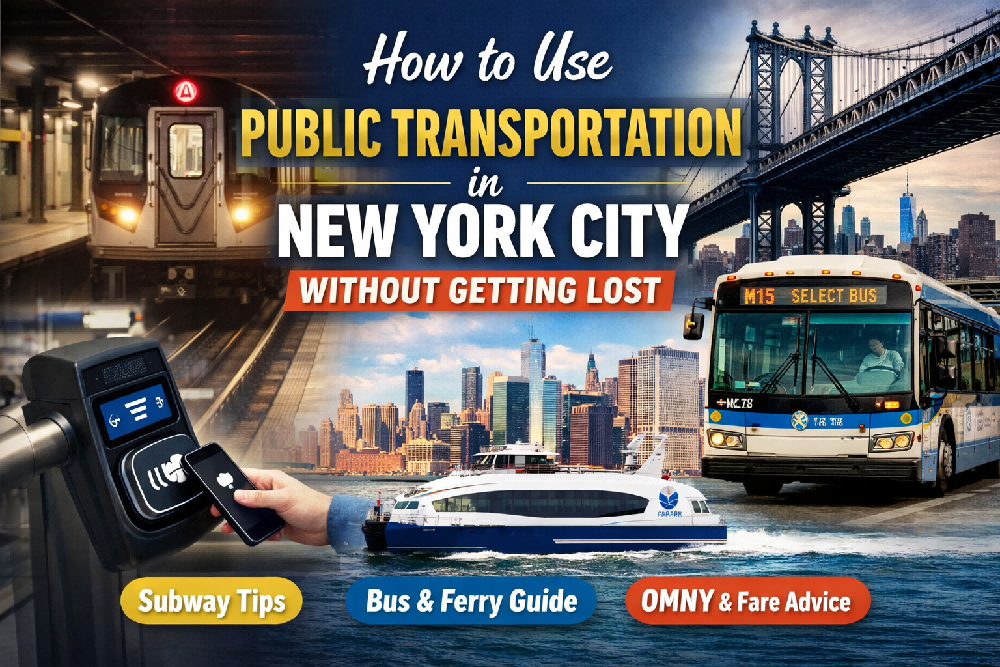
New York City moves fast, and its public transportation system is a big reason why. For locals, taking the subway or bus is just part of everyday life. For visitors, though, it can feel overwhelming at first. The good news is that once you understand a few basics, getting around NYC becomes much easier, cheaper, and often faster than using a car or ride-share.
If you are planning a trip to New York City, learning how public transportation works can save you time, money, and stress. The city’s transit network includes the subway, local buses, express buses, the Staten Island Railway, and ferry options, with the subway and bus system run by the MTA. OMNY tap-to-pay is now the main way many riders pay, and the standard subway or local bus fare is currently $3. MetroCard is still accepted into 2026, but the MTA says it is being phased out later. (MTA)
Why Public Transportation Is the Best Way to Get Around NYC
Driving in New York City sounds convenient in theory, but in reality it usually is not. Traffic can be intense, parking is expensive, and many of the most popular parts of the city are easier to reach by train or bus. Public transportation lets you move through Manhattan, Brooklyn, Queens, the Bronx, and Staten Island without constantly worrying about parking or surge pricing.
For most visitors, the subway is the quickest option for longer distances, while buses are useful for shorter trips or for neighborhoods where subway access is less direct. Ferries can also be a scenic and enjoyable choice for some routes. The MTA’s official guides emphasize that the subway is one of the easiest and most convenient ways to travel around the city, while buses and ferries also have route and payment tools designed for riders. (MTA)
Start With the Subway
If you only learn one part of NYC public transportation, make it the subway. It runs across much of the city and is usually the fastest way to travel between major neighborhoods and tourist areas.
The first thing to understand is that subway lines are identified by letters or numbers, not just colors. On a map, you may see several lines in one color, but what really matters is the specific train you need, such as the A, C, E, 1, 2, or 3. A common beginner mistake is following only the color and ending up on the wrong train.
The next thing to know is the difference between uptown and downtown in Manhattan. In simple terms, downtown usually means heading south, while uptown means heading north. In other boroughs, signs may show the name of the final destination instead. Always check the platform sign before you go down the stairs.
It also helps to understand local versus express trains. Local trains stop at every station. Express trains skip some stations, which makes them faster but not always better if your stop is one they skip. Before boarding, glance at the map or app and make sure your train actually stops where you need to go.
How to Pay for Rides
Paying for transit in New York is easier than it used to be. The MTA now promotes OMNY, a tap-and-go payment system that works with contactless credit cards, debit cards, smartphones, smartwatches, and OMNY cards. For many travelers, this is the simplest option because you do not need to buy a separate transit card first. The MTA also says that after 12 paid rides in a 7-day period, additional rides are free under the fare cap, up to the weekly limit for full-fare riders. (MTA)
You can still use a MetroCard for now, which may feel familiar if you have visited New York before. But if you are coming for a short trip in 2026, OMNY is usually the easier choice.
A few practical tips:
- Use the same device or card each time if you want your rides to count properly toward any fare cap.
- Have your payment method ready before you reach the turnstile or bus door.
- If you are traveling with a group, remember that one phone or one bank card may not work the way you expect for multiple riders in every situation, so separate payment methods can be easier.
Taking the Bus in NYC
Visitors often ignore the bus, but that is a mistake. Buses can be very useful, especially when you are going crosstown in Manhattan or traveling within neighborhoods where subway stations are farther apart.
According to the MTA’s bus guide, riders can tap to pay on the bus with OMNY, use MetroCard, or in some cases pay cash, depending on the service type. The guide also explains transfers and stop information. (MTA)
The biggest advantage of the bus is that it is less confusing visually. You can see the street, follow your location more easily, and get off if something feels wrong. If you are nervous about navigating NYC for the first time, a bus can feel less stressful than diving underground into the subway system.
That said, buses are usually slower because of traffic. They are best when:
- your destination is not far away,
- you want a more scenic ride,
- or the subway route feels indirect.
Don’t Forget the Ferry
NYC Ferries are not the main transit option for most trips, but they can be a great experience. They connect parts of Manhattan, Brooklyn, Queens, the Bronx, and Staten Island routes in a way that can be both practical and enjoyable. They also give you beautiful skyline and waterfront views that you will not get underground.
NYC Ferry’s official site says one-way fare is currently $4.50, with additional pass options available through its ticketing system and app. (New York City Ferry Service)
If your route works well with the ferry, it can be one of the most memorable ways to travel in the city.


